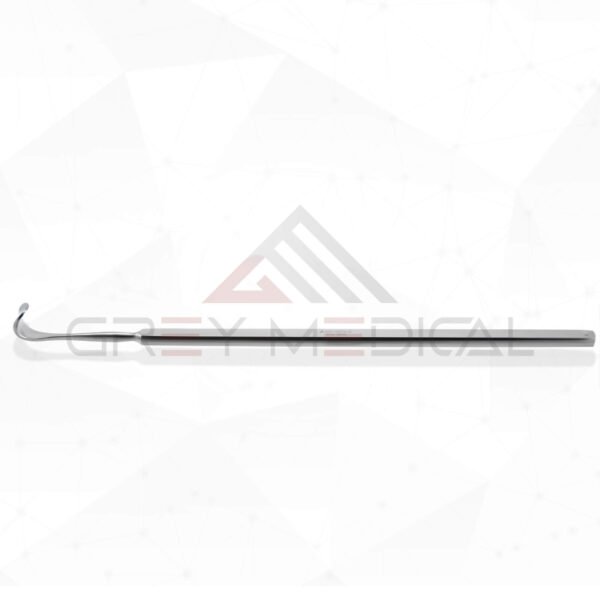
When you step into a modern operating theatre, you are surrounded by advanced technology. Yet, amidst the glowing monitors and robotic arms, a few foundational instruments remain entirely indispensable. One of these is the Cushing retractor. A masterpiece of retractor surgical instrument design, this seemingly simple tool plays a critical role in delicate procedures.
If you have ever wondered how surgeons safely navigate around fragile nerves and blood vessels, the answer often lies in the tools they hold.
The Legacy of Dr Harvey Cushing
To understand the Cushing retractor, you must first look at the man who gave it its name. Dr Harvey Cushing (1869–1939) is widely regarded as the father of modern neurosurgery. Before Cushing, operating on the human brain was a desperate measure with notoriously low survival rates.
Cushing transformed this field entirely. He introduced meticulous surgical techniques, championed the use of blood pressure monitoring, and dramatically reduced patient mortality. Because his work required navigating the most delicate tissues in the human body, standard surgical tools were simply inadequate. He needed instruments that offered unprecedented control.
This necessity drove him to design his own tools, including the Cushing retractor. His invention allowed surgeons to gently hold back tissue without causing unnecessary trauma, a principle that remains at the very core of safe surgical practice today.
Anatomy of the Cushing Retractor
What makes the Cushing retractor so effective? The genius of this instrument lies in its subtle, highly refined design. It is not just a piece of metal; it is an extension of the surgeon’s hand.
Ergonomic Handle Design
Surgical procedures often last for several hours. Hand fatigue can easily compromise a surgeon's precision. The Cushing retractor addresses this directly through its handle design.
- Tear-drop or fenestrated shape: Many variations feature a hollowed-out or contoured handle. This reduces the overall weight of the instrument while providing a secure, comfortable grip.
- Tactile feedback: The handle connects seamlessly to the shaft, allowing the surgeon to feel the exact amount of tension they are applying to the tissue.
- Non-slip grip: Surgical gloves become slippery. The textured grip ensures the retractor stays firmly in place, even during high-pressure moments.
Blade Shape and Profile
The blade is the business end of the retractor, and its design is perfectly tailored for fragile environments.
- Saddle-style curve: The blade typically features a gentle, saddle-like curve. This distributes pressure evenly across the retracted tissue, preventing pinpoint compression that could damage tiny blood vessels.
- Smooth, blunt edges: Unlike retractors designed for tough muscle or fascia, the Cushing retractor has incredibly smooth edges. It easily slides past delicate structures without tearing them.
- Narrow profile: The slender nature of the blade allows it to fit into tight surgical corridors, providing an unobstructed line of sight for the operating team.
Applications in Modern Surgery
Despite being invented over a century ago, the Cushing retractor remains a staple in modern surgical kits. Its ability to manage delicate tissues makes it highly versatile across several disciplines.
Neurosurgery
In the brain and spinal cord, there is absolutely no margin for error. The Cushing retractor is frequently used in craniotomies and spinal decompression surgeries. Surgeons use it to gently elevate the dura mater or gently hold back the soft tissues surrounding the spinal column. The blunt edges ensure that nerve roots and delicate meninges remain unharmed while the surgeon works to remove a tumour or relieve pressure.
Orthopaedic Surgery
While we often associate orthopaedics with heavy-duty tools, many procedures require extreme finesse. When operating on hands, wrists, or feet, surgeons encounter a dense web of tendons, ligaments, and nerves. The Cushing retractor is perfect for these environments. It allows orthopaedic surgeons to safely pull back superficial tissues and expose the underlying bone or joint capsule without causing collateral damage.
Precision Meets Safety
The ultimate goal of any surgical instrument is to improve patient outcomes. The Cushing retractor perfectly embodies the critical balance between manual precision and patient safety.
In an era where surgical technology is rapidly advancing, you might expect manual retractors to become obsolete. However, a robotic arm cannot always replicate the nuanced, tactile feedback of human touch. When a surgeon uses a Cushing retractor, they can instantly feel the resistance of the tissue. They know exactly when to apply a little more pressure and when to ease off.
This sensory feedback loop protects the patient. It prevents ischaemia (restricted blood flow) in the retracted tissues and drastically reduces postoperative swelling and pain. By combining the surgeon's skill with an instrument designed specifically for gentleness, the Cushing retractor minimises surgical trauma.
The Enduring Relevance of a Classic Instrument
The Cushing retractor is much more than a piece of surgical steel. It is a physical representation of surgical evolution. Dr Harvey Cushing designed this tool to solve a specific problem: how to see clearly without causing harm. Decades later, his solution remains virtually unchanged because it simply works.
From the quiet focus of a neurosurgical suite to the careful reconstruction of an orthopaedic procedure, the Cushing retractor continues to quietly save lives and preserve function. It proves that while medical science constantly moves forward, truly exceptional design never goes out of style.
If you are a medical student or a surgical enthusiast, take the time to study these classic instruments. Understanding the tools of the trade will give you a much deeper appreciation for the art and science of modern surgery.
Comments